RUBINA’S RADAR | YOU’RE DOING AMAZING SWEET AND GREEN MUMBAI!

OCTOBER 10, 2023

There’s always something new happening in Mumbai. And when it’s sweet and delicious like cupcakes and macarons and green like forests, the only way to describe it is by saying, “You’re doing amazing, sweet and green Mumbai!” like Kris Jenner would. Except Jenner had said “You’re doing amazing sweetie” to her daughter Kim Kardashian posing for a Playboy magazine shoot, circa 2007 – a cult sentence in pop culture since.

MUMBAI: New York’s Magnolia Bakery is finally opening in Bandra, Mumbai on November 1st, 2023, five years after marking its sweet presence in India. Magnolia first opened in Bangalore in November 2019, expanding to four locations in the city since, and opened its fifth outpost in Hyderabad in November 2022. The first Magnolia Bakery was opened by Jennifer Appel and Allysa Torey in New York in 1996, but went on to change a few hands in its ownership over the years. Magnolia Bakery’s delicious cupcakes and frosted desserts became so popular that it started the cupcake craze in the 90s, with starring pop cultural mentions in the hit television series, Sex And The City and the film, The Devil Wears Prada, and many other film and television shows. The mention of the bakery on an episode of Sex And The City gave it immediate fame, so much so that it became a tour bus stop in New York. Magnolia’s first outpost outside the US was opened in Dubai in 2010, followed by one in Abu Dhabi in the UAE and in countries like Qatar, South Korea, Saudi Arabia, Jordan and of course, India. Since 2021, Magnolia is owned by a private equity firm co-founded by Hudson Yards developer, Stephen Ross. I have only ever had Magnolia in New York, so bring on the deliciousness!

©Magnolia Bakery, New York

MUMBAI: The 161-year-old French patisserie, Ladurée Paris is also opening in Mumbai at the Jio World Plaza Mall in November, around Diwali, to make the festivities in the city even sweeter. Headquartered in Paris, France, Ladurée is an ambassador of Parisian macarons with their exquisite pastry art. Ladurée Paris first opened in India about two years ago in New Delhi’s Khan Market in September 2021. In 1862, Louis-Ernest Ladurée opened a bakery called Maison Ladurée in La Madeleine, but had to reinvent it as a pastry shop following a fire in the Paris Commune uprising in 1871. The Parisian macaron, as we know it today, was created by Parisian pastry chef, Pierre Desfontaines, second cousin of the creator of Maison Ladurée, who had the ingenious idea of ​​assembling two macaron shells, with a tasty ganache. And voila, the beloved double decker macaron came into existence. It is said that 15000 Ladurée macarons are sold everyday around the world, and the sales in Mumbai will definitely add to that count. 2023 is the year Ladurée celebrates and honours Empress Eugénie, wife of Napoleon III, also known as Louis Napoleon Bonaparte, with a macaron called Eugénie. Can’t wait to try the Eugénie macaron with a crunchy biscuit and a melting centre coated in chocolate, and my forever favourite, the Barre Chocolat.
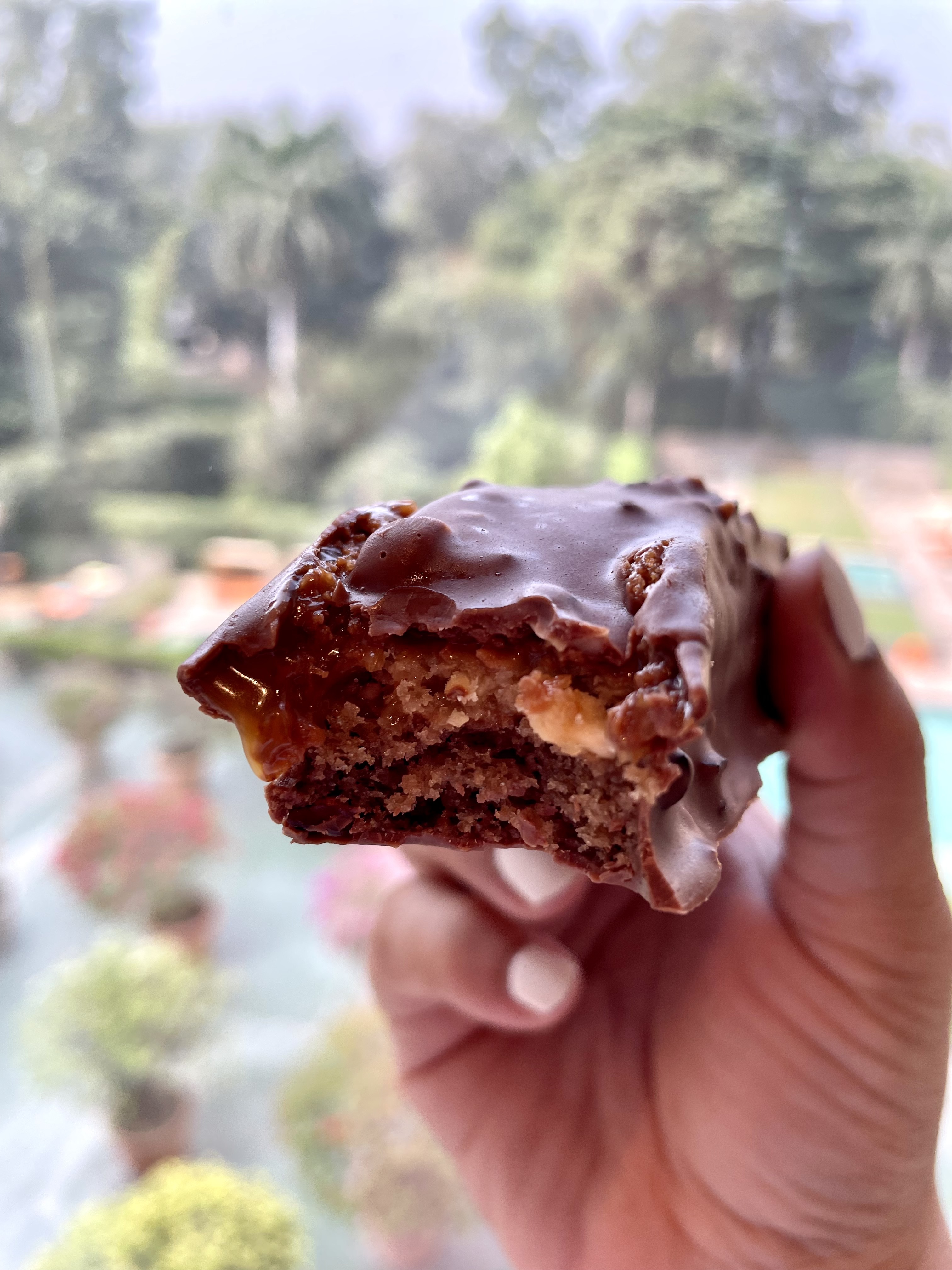
Laduree’s Barre Chocolat photographed by Rubina A Khan

MUMBAI: The Indian Hotels Company Limited opened a new hotel in Mumbai, Taj The Trees, in Pirojshanagar, Vikhroli on September 19th, 2023. Spread over eight acres in the eastern suburb of Vikhroli along the Eastern Express Highway, Taj The Trees has views of the Mangrove Forest on one end and a Sculpture Park on the other. The hotel has 140 rooms and 11 suites, a spa and wellness centre with an infinity pool and 3 restaurants – Shamiana, Nonya and a rooftop bar on the 12th floor, The Mangrove Bar. Taj The Trees is the coming together of two of India’s greatest business legacies for the first time – the Tata Group and the Godrej Group. The hotel is owned by Godrej Properties and is managed by the Indian Hotel Companies as a luxury Taj hotel. Pirojsha Godrej, Executive Chairperson at Godrej Properties said, “We are happy to open our first hotel, Taj The Trees, in partnership with the Tata Group, as we aim to deliver quality and sustainable luxury in a green, connected, and vibrant neighbourhood.” The green mangrove trees and the languid shoreline make for great visuals in a city where the skyline is dominated with concrete towers and buildings. It remains to be seen what kind of efforts and policies have been adopted and adapted by IHCL towards making this a green forward hotel, aside from glass water bottles and linen changes that are the bare minimum in every luxury hotel worldwide. Taj The Trees is quite a tongue-twister, so T3 is what I think it will soon be called, not to be mistaken as a new airport terminal in Mumbai though. Along with the Taj Mahal Palace and Tower, Wellington Mews, Taj Land’s End and Taj Santacruz, Taj The Trees is the fifth hotel under the Taj brand to open in Mumbai.

©Taj The Trees

It is rather unimaginable to think of Mumbai as green, where grey concrete is a defining colour, but the idea of waking up to verdant forest views feels calming and energising.

Disclaimer: Any part of the content on the rubinaakhan.com website cannot be reproduced without prior permission and crediting the website and the author.
©Rubina A Khan 2023

India Tourism: How ‘Revenge Travel’ Saved The Industry | BBC

More than two years after the Covid pandemic halted travel, India’s tourism and hospitality industry is now cautiously hopeful. Independent journalist Rubina A Khan writes for the BBC on what’s driving the optimism. 

Tourism constituted almost 3% of India’s GDP and generated around 100 million jobs in 2019. But the sector was severely hit in India – like in other countries – when the pandemic struck. Only 2.74 million foreign tourists visited India in 2020 compared with 10.93 million the year before, official data shows. While the number of foreign visitors is still nowhere close to pre-pandemic levels, travel company operators and hotel industry executives say an upsurge in domestic tourists is making them more upbeat. 

After two years of being cooped up inside, Indians are now travelling with a vengeance – ‘revenge travel’, as the phenomenon is called. And many, experts say, now prefer to travel within the country instead of flying to more expensive destinations abroad. The industry is also benefiting from new trends borne of the pandemic, such as micro-holidays and workcations. Deep Kalra, founder and chairman of travel website Make My Trip, says the sector started seeing an upturn in the last quarter of 2020, and has been consistently recovering ever since. “In fact, the last three fiscal quarters have operationally been the most profitable ones for our company,” he says.

EXPLORING INDIA

Experts say the pandemic offered Indians an opportunity to explore their own country. India has always been a popular tourist destination. From historic forts and stunning palaces to dense jungles, there’s no shortage of options for visitors. But with international travel disrupted for months, more and more Indians became open to the idea of vacationing within the country, says Vishal Suri, the managing director of travel company SOTC. “The pandemic has given Indians a new-found appreciation for the outdoors,” Mr Suri says. He adds that there has been an uptick in demand for unexplored destinations – people are seeking ways to combine pilgrimages and spiritual trips with experiencing local food, cultural trails and adventure.

The pandemic also generated new trends such as staycations and workcations – combining remote working with vacations. “Travellers are now extremely comfortable with booking homestays that offer exclusivity, privacy, and the comfort of a home away from home,” says Pradeep Shetty, a senior official at the Federation of Hotel and Restaurant Associations Of India (FHRAI). Mr Kalra from Make My Trip agrees – he says that people have warmed up to the idea of travelling within India whenever possible. “Even the travel frequency has changed and become more regular. The annual break has now turned into micro-holidays with people increasingly taking more breaks in the form of multiple weekend getaways and seasonal holiday breaks,” he says.

IMPACT ON HOSPITALITY SECTOR

This shift has turned out to be a revenue-spinner for hotels in India, as people are now willing to use the money they would normally reserve for their international vacations on better facilities domestically. Some luxury hotels dropped their prices at intervals in the pandemic, leading to a spike in bookings and short-term revenues. Puneet Chhatwal, the managing director and CEO of The Indian Hotels Company Ltd (IHCL) – India’s largest hospitality company which operates the Taj chain of luxury hotels – says that after each successive Covid wave, the recovery was “stronger and quicker”. “The IHCL’s occupancy figures today exceed the pre-pandemic levels – a resurgence that is primarily fuelled by domestic tourism,” he adds.

Raffles Udaipur – run by international hotel chain Raffles – is situated on a private island and opened in August 2021, just months after the devastating second wave of the pandemic in India. But the hotel has seen a “healthy rate of occupancy” every month throughout its first year of operations in India, says Puneet Dhawan, the hotel’s senior vice-president for India and South Asia. “While we have no pre-pandemic metric to compare to, we have observed a steady rise in the response to our property,” he adds. Mr Dhawan says the hotel is gearing up for an even busier year ahead – starting with the tourist rush in winter and the upcoming wedding season. Mr Kalra says there are other positive signs too, such as the resumption of corporate travel – a trend that is likely to increase in the coming quarters, aiding overall recovery for the travel industry. 

CHALLENGES

But despite the optimism, people in the industry say that domestic tourism alone cannot take the sector back to the pre-pandemic-level of growth. In September, India’s tourism minister said that the government was working towards the all-round revival of the tourism sector. But foreign arrivals continue to be dismal – data shows they dipped by 44.5% in 2021 compared with the year before. “India has not released a single campaign inviting the world to us. What we need is a stellar marketing strategy that excites travellers enough to choose us, especially the 60 million people that used to travel to China and aren’t today,” says Dipak Deva, managing director of the Travel Corporation of India, one of India’s best-known travel agencies. He adds that the government also needs to restore its e-visa facility – especially for countries such as the UK from where a large number of tourists visit India – as the current procedure is too cumbersome.

However, Mr Kalra feels that both domestic and international travel are “here to grow together, and not against each other”. “With international travel now returning to the fore, we are confident that in a few quarters, international travel will also be able to recover completely.”

This feature first appeared on BBC on October 7th, 2022

©Rubina A Khan 2022